
If you have acne-prone skin, then you are always looking for effective ways to prevent and minimize your breakouts. As LED light therapy is becoming more accessible through tons of at-home devices. So many acne-prone people want to know if it can help tame their breakouts. And that’s a reasonable goal, because LED isn’t just “a spa trend.” There’s real clinical data behind a combination of blue and red light for mild-to-moderate acne. But it’s also easy to get disappointed if you expect it to work like a strong prescription, or if your device/routine doesn’t match what studies actually tested.
Why “acne LED” is confusing online
If you have done a quick search on LEDs to manage your acne, you might have seen mixed results. And the mixed positive and negative comments can make it confusing to decide if LEDs can actually help. Most confusion comes from three things:
- “Acne” is not one problem. Inflamed pimples behave differently from blackheads.
- Not all LED devices are comparable. Wavelength and dose matter more than “number of bulbs.”
- LED is gradual. Even when it works, it tends to work over weeks of consistent use, not overnight.
How LED light therapy can improve acne (simple mechanism)
Although LED light therapy is becoming more popular, it is not a new skincare treatment. The LED light therapy masks and handheld devices for at-home treatments are based on well-established science; they are just becoming much more affordable. So let’s talk about the science behind LEDs for acne treatment.
Blue light: targets acne bacteria (and some inflammation)
Blue light (roughly 415–460 nm) mainly reaches the upper layers of skin. Its key action is that it’s absorbed by porphyrins produced by Cutibacterium acnes, one type of acne-causing bacteria. Porphyrins are small molecules that are important for keeping the bacteria alive. When these small molecules absorb the blue light, it triggers a photochemical reaction that creates reactive oxygen species, which can damage the bacteria.
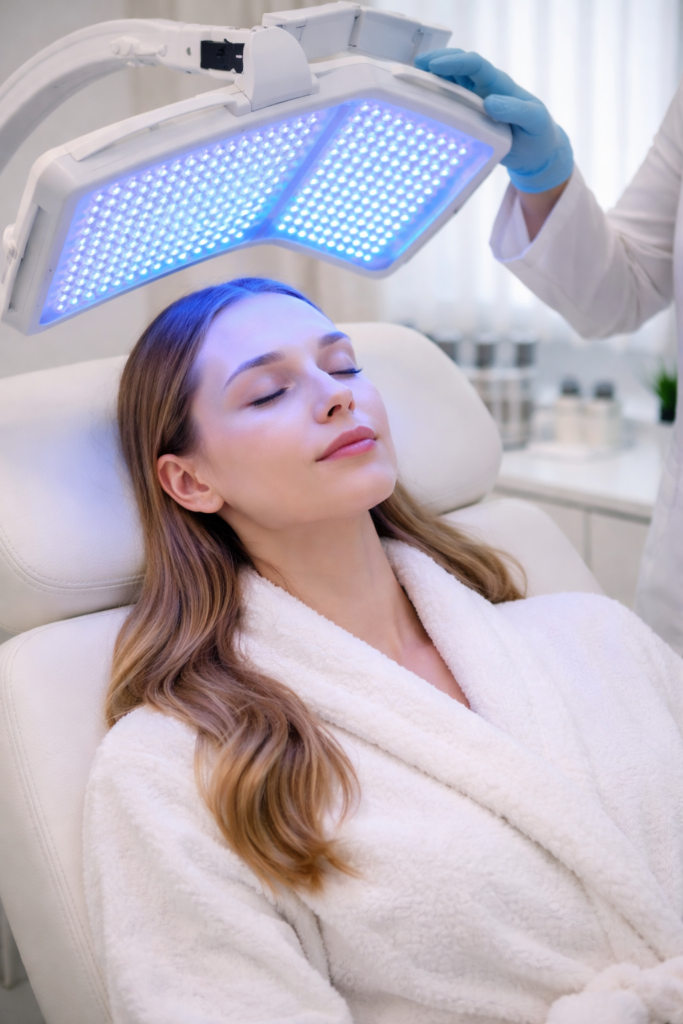
Blue light can also shift inflammatory signals in skin, which may help calm redness over time.
Red light: supports anti-inflammatory effects deeper in the skin
Red light (around 630–660 nm) penetrates deeper than blue and is commonly paired with blue for acne. In the white paper, red light is described as complementing blue by helping calm inflammation and affecting deeper targets (including your oil-producing sebaceous glands that feed the bacteria).
Why blue and red together are important: Blue addresses bacteria-related pathways, while red supports anti-inflammatory effects, so the combo tends to outperform either one alone.
What the clinical evidence shows for at-home LED acne devices
There are quite a few scientific studies that show results you can expect from an at-home LED device if you are trying help manage your acne. Scientific studies show that at-home LED devices really do help people manage mild-to-moderate acne. The clinical studies prove that using these devices consistently leads to clearer skin, especially when it comes to red, painful bumps. For example, one seven-week study found that nearly 9 out of 10 people saw their acne get better after using an LED mask just four times a week. Another trial showed that a handheld device used twice a day cut down red spots by 77%, while a fake device did nothing at all. A large 2025 review of many different studies confirmed that while both red and blue lights work, using them together gives the best results. Overall, these devices are a great choice for anyone wanting to improve their acne management routine.
What LED helps most (and what it helps least)
Most responsive: inflammatory acne
The research shows that at-home LED devices are most effective on inflammatory pimples. Inflammatory pimples tend to respond first, often with less redness and smaller lesions after a few weeks. This is related to the mechanism we discussed previously, where the blue light is absorbed by the small molecules, porphyrin important for keeping the bacteria alive.
Less responsive: blackheads and closed comedones
Non-inflammatory lesions are less responsive to at-home LED treatments, partly because comedones lack the porphyrin targets that blue light acts on.
Practically, if your acne is mostly clogged pores with a few inflamed bumps, LED may be a “nice extra,” but it’s less likely to be the main fix.
What “at-home” success usually requires (dose + schedule)
Home devices are generally lower power than professional panels, so positive results depend on repeating sessions consistently. Most studies show that favorable results come when the device is used approximately10- 20 minutes per session, at least 3-4 times per week. The studies also describe a realistic improvement timeline of 4- 8 weeks.
Why results vary so much between people
So if the science is so conclusive about at-home LED devices for acne, why are there such varying results? Even with sound science, acne outcomes vary because:
- The device should be “FDA cleared,” while there are many affordable options that are not FDA cleared, meaning they don’t have evidence supporting their effectiveness.
- Your acne type may not match LED’s strengths. Inflammatory acne tends to respond better than comedones.
- Dose and adherence differ. The studies that worked used frequent sessions over weeks.
How to use LED for acne at home (a realistic routine)
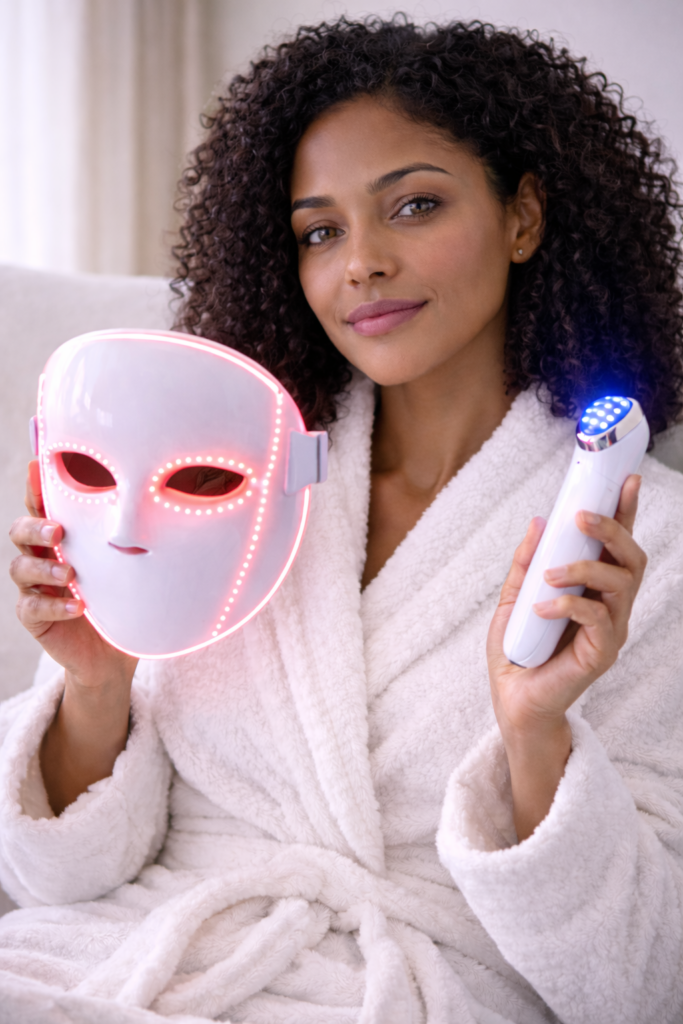
If you are considering an at-home LED mask to help manage your acne, here is a good way to start incorporating it into your at-home routine based on research to maximize your results.
- Frequency: 3- 4x/week minimum (often more consistent = better)
- Session length: 10-20-minute sessions for each use
- Timeline: judge results after ~6- 8 weeks of consistent use, not after a few uses
- Maintenance: wipe the mask clean with alcohol after each use.
Reep at-home LED masks are a supporting player in your skincare routine to manage your acne. They are useful alongside standard skincare rather than a replacement for everything else.
So at-home LED masks can help manage acne, but are they safe…
LED masks are generally described as non-thermal and well-tolerated when used as directed. Studies show only mild temporary effects like slight redness or dryness reported in some users.
Additionally, there are a few acne-relevant cautions:
1) Protect your eyes (especially with blue light)
For all at-home LED devices, eye protection is crucial. Particularly, blue light at high intensity can harm your retinal cells.
2) Avoid LED if you’re on photosensitizing meds (unless your clinician okays it)
Clinical trials excluded people using photosensitizers. The paper lists examples (including certain antibiotics and isotretinoin) and advises medical guidance before using an LED mask if you’re on these medications.
3) Pigmentation-prone skin: be cautious with blue light
If you are pigmentation-prone there is some evidence blue light can induce melanin production in darker skin types and may worsen melasma or post-inflammatory hyperpigmentation with excessive exposure. It suggests that melasma-prone users avoid blue modes and focus on red/NIR if using LED at all.
How to choose an at-home LED device for acne (without chasing “best lists”)
Instead of shopping by brand hype, shop by “does this match the evidence?”
Look for:
- Blue and red wavelengths used in acne trials (415 nm blue + ~633 nm red)
- FDA-cleared for acne when possible
- A schedule that fits your life, because consistency drives outcomes (10–20 minutes, multiple days/week)
Don’t over-weight:
- “Number of LEDs” (not the same as dose)
- extra colors with weak evidence (nice-to-have, not the core acne story)
Wrap-up: the “realistic promise” of LED light therapy for acne at home
Based on the evidence, at-home blue and red LED therapy can be a legitimate acne support tool in your skincare routine.
If you want the broader framework for judging any at-home LED claim for common skincare concerns (acne, anti-aging, pigmentation), start with the hub.
If you find this kind of evidence-based breakdown helpful, I share deeper analyses and updates through my email list.
References
Ablon, G. (2025). A 7-week, open-label study evaluating the efficacy and safety of 415-nm/633-nm phototherapy for treating mild-to-moderate acne in adolescents and adults. The Journal of Clinical and Aesthetic Dermatology, 18(10), 25–32.
Barolet, D. (2018). Dual effect of photobiomodulation on melasma: Downregulation of hyperpigmentation and enhanced solar resistance—A pilot study. The Journal of Clinical and Aesthetic Dermatology, 11(4), 28–34.
Goldberg, D. J., Amin, S., Russell, B. A., Phelps, R., Kellett, N., & Reilly, L. A. (2006). Combined 633-nm and 830-nm LED treatment of photoaging skin. Journal of Drugs in Dermatology, 5(8), 748–753.
Lee, S. Y., Park, K.-H., Choi, J.-W., Kwon, J.-K., Lee, D. R., Shin, M. S., Lee, J. S., You, C. E., & Park, M. Y. (2007). A prospective, randomized, placebo-controlled, double-blinded, and split-face clinical study on LED phototherapy for skin rejuvenation: Clinical, profilometric, histologic, ultrastructural, and biochemical evaluations and comparison of three different treatment settings. Journal of Photochemistry and Photobiology B: Biology, 88(1), 51–67.
Li, L., Jiang, X., Tu, Y., Yang, Y., Zhang, X., Gu, H., & He, L. (2023). Impact of blue light on skin pigmentation in patients with melasma. Skin Research and Technology, 29(7), e13401.
Park, S. H., Park, S. O., & Jung, J.-A. (2025). Clinical study to evaluate the efficacy and safety of home-used LED and IRED mask for crow’s feet: A multi-center, randomized, double-blind, sham-controlled study. Medicine (Baltimore), 104(7), e41596.
Regazzetti, C., Sormani, L., Debayle, D., Bernerd, F., Tulic, M. K., De Donatis, G. M., Chignon-Sicard, B., Rocchi, S., & Passeron, T. (2018). Melanocytes sense blue light and regulate pigmentation through Opsin-3. Journal of Investigative Dermatology, 138(1), 171–178.
Scott, A. M., Stehlik, P., Clark, J., Mackenzie, H., Grant, S., Glasziou, P., & Del Mar, C. B. (2019). Blue-light therapy for acne vulgaris: A systematic review and meta-analysis. Annals of Family Medicine, 17(6), 545–553.
Barolet, D., & colleagues. (2023). Low-intensity visible and near-infrared light-induced cell signaling in skin photobiomodulation (review).